
Hyperscaler exit
Hybrid Azure: M365 at Microsoft. Regulated AWS core on Hikube.
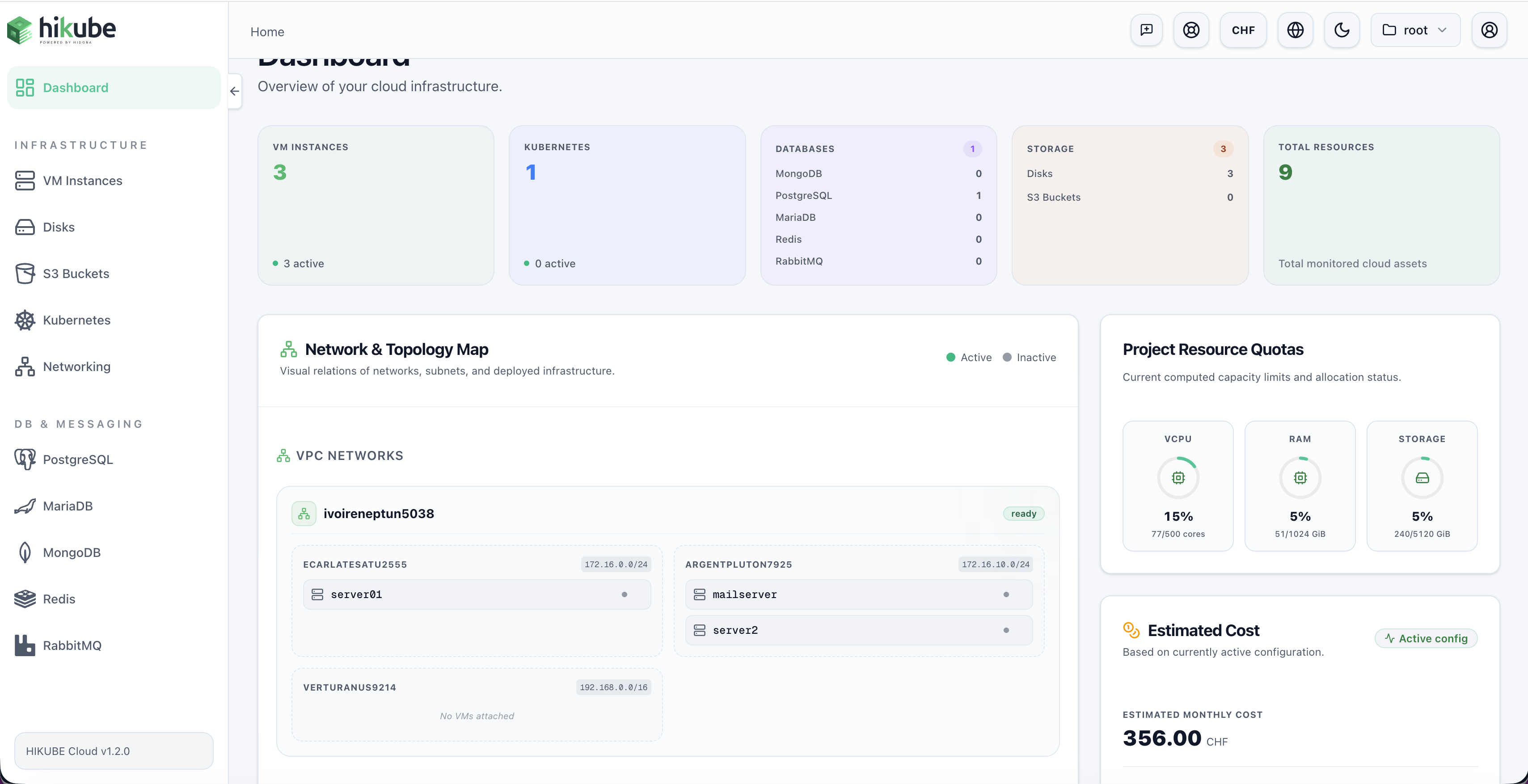
Hyperscaler exit to Hikube is a hybrid model: Microsoft 365 stays at Microsoft; IaaS, Kubernetes, data and backups can run on Hikube (Hidora SA, Geneva, Gland, Lucerne). On AWS, we move the core where the CLOUD Act hurts, not the global Marketplace. Control: Hikube API and console. Terraform: in preparation.
- Target
- API
- TCO
- ISO 27001
- 3 DC
- SLA 99.99%
Two public paths, one operator. Azure: hybrid, compared on the Azure comparison. AWS: the regulated core, compared on the AWS comparison. GCP: the same CLOUD Act logic; the published comparisons cover AWS, Azure and VMware. TCO calculator in CHF. 14-day trial, no credit card. GPUs included. Support FR/EN.
Path
01
Target
Microsoft 365 stays at Microsoft. List IaaS, Kubernetes, data and backups where Swiss residency matters. On AWS: VMs, EKS-like, line-of-business S3, copies. Not the whole Marketplace.
02
API
Hikube API and console today. Terraform and Cluster API integration in preparation. S3 clients, kubectl and Helm stay. Rewrite resources, not the IaC philosophy.
03
TCO
36-month TCO calculator in CHF, then an engineer quote for GPU and Windows (10 CHF/vCPU). IN/OUT traffic is not billed. This is not a hyperscaler quote.
04
Trial
14 days, no credit card. GPUs included. Regulated volumes: the same trial, with framing. Request a trial, or talk to an engineer.
In detail
The one on the Azure comparison. Microsoft 365 stays at Microsoft: mail, collaboration, SaaS identity. Entra is not remapped 1:1. IaaS, AKS-like Kubernetes, data and backups can run on Hikube, operated by Hidora SA in Geneva, Gland and Lucerne. Switzerland North fixes latency, not the operator: Microsoft remains a US group, CLOUD Act included. Windows Server is a licensed image on Hikube instances (10 CHF/vCPU/month). Azure PaaS (Functions, Cosmos) has no 1:1 twin. We do not force a full repatriation.
The workloads where jurisdiction and Swiss residency matter: VMs, EKS-like Kubernetes, line-of-business object storage, common databases (PostgreSQL, MariaDB, Redis, MongoDB, ClickHouse), backup and vault. A Zurich region does not change AWS’s group nationality. Hikube wins on a Swiss operator, native 3-site replication (block sync or async, different RPO), IN/OUT traffic not billed. AWS wins on catalogue, Marketplace and global footprint. Many teams keep an AWS account for non-sovereign work. Detail: the AWS comparison.
Same CLOUD Act logic: Google is a US group, including with a European region. GCE-like, GKE-like, GCS-like and GPUs in the 14-day trial can move. Not global BigQuery, not Vertex at Google scale. kubectl, Helm and GitOps stay. An engineer frames the scope. We do not publish a bake-off against every Swiss or European cloud.
Coming, with Cluster API. Today: Hikube API and console. S3 clients (AWS CLI, rclone, SDK) and Kubernetes (kubectl, Helm) stay. AWS or azurerm providers do not map 1:1. A tender that requires Terraform in production today does not yet match the catalogue. An engineer says so at framing.
Leaving a hyperscaler does not stall on the machines: it stalls on what exists only there. Take the inventory in this order, from most portable to least, and within a day you will know whether the project is a move or a rewrite.
- Portable without discussion: VMs, volumes, object buckets, container images, common relational and document databases
- Portable with work: Kubernetes clusters, whose manifests follow but whose load balancer annotations, storage classes and IAM roles are provider-specific
- To rewrite or to leave where they are: proprietary services with no equivalent, serverless functions, proprietary databases, in-house queues and buses, identity services. There is no shame in leaving some behind
- What does not move at all: Microsoft 365 stays with Microsoft, and saying so up front avoids a disappointment mid-project
- The constraint discovered late: the cost and duration of getting the data out, billed per gigabyte by most providers. Cost it before deciding, not after: what egress fees cost
Six steps, and the sixth is not a failure: a path with no prepared rollback is not a path, it is a bet. The detailed method, command by command, is in /blog/migration-cloud-souverain-guide-2026; this page gives the arc and the responsibilities.
- Pick the pilot: an application that crosses at least one hard dependency, tolerates announced downtime, and whose business owner answers the phone. Not the most critical, not the easiest
- Prepare: network, identities, secrets and backup in place before the first byte. A backup switched on after the migration does not protect the migration
- Coexist: both platforms run in parallel, linked by VPN. This is the most expensive and most reassuring phase: budget it, it lasts longer than planned
- Migrate in waves, starting with what tolerates downtime: each wave validates the next one’s runbook
- Validate against criteria written in advance: the service answers, writes reach the database, response times hold the envelope measured before, the migrated workload’s backup is taken and verified
- Keep rollback open: the original environment stays bootable, the decision deadline is set before the window, and one named person calls it. The source account is closed only after the last validated wave
Hidora SA operates the hypervisor, the three DCs, the VPC, block replication (sync or async, not the same RPO), platform backup and FR/EN engineer support. You keep OS, apps, GitOps, topology spread and PDBs for pods (Hikube spreads Kubernetes workers, you do not choose the DC), database schemas and the restore runbook. No AWS or Azure console for that compute: Hikube API and console.
Line-of-business backups and object storage (a us-east-1 bucket breaks the file). Already containerised Kubernetes clusters. Linux or Windows IaaS VMs (10 CHF/vCPU). Catalogue databases, not Aurora or Cosmos. Inference or fine-tuning GPUs in the trial. This is not the first step of a VMware exit still on VMs: that path is the VMware exit. SMEs: often a first VM, catalogue open, the 14-day trial.
The calculator compares Hikube, AWS and Azure over 36 months, in CHF. Order of magnitude, not a quote. GPU and Windows are sized with an engineer. IN/OUT traffic is not billed: leaving Hikube is not egress-taxed the way leaving AWS or Azure is. Published case studies stay qualitative.
Hikube does not offer single-AZ EBS. Volumes are network NVMe, always geo-redundant across Geneva, Gland and Lucerne, synchronous (real time) or asynchronous (improved performance) replication. Sync and async do not share the same RPO. No unreplicated local volume. We publish neither RPO nor IOPS. Do not add a multi-AZ SKU in the TCO: geo-redundancy is already in the instance price. Detail: block storage.
Managed MongoDB is a Hikube catalogue engine, operated in Switzerland, in the VPC. It is not Atlas, not FerretDB, not DocumentDB, not Cosmos. PostgreSQL and MariaDB cover widely deployed SQL (no separate MySQL SKU). Redis and ClickHouse complete the set. A Swiss cluster that still points at US Atlas breaks the residency file. Hub: the five managed database engines.
No. Hikube automatically distributes workers (node groups) across Geneva, Gland and Lucerne. You do not place nodes like AWS AZs. Topology spread and PDBs for pods stay yours. Hidora SA (KCSP) control plane, Certified Kubernetes Hosted, Talos. GPUs in the trial: L4, L40S, A100-80, RTX 6000 Pro, H100, H200, not a worldwide farm. Detail: the Kubernetes platform.
No. Many SMEs start with a Linux or Windows VM, billed in CHF, from 24 CHF/month (s1.small). Windows: licensed image at 10 CHF/vCPU. Kubernetes, GPUs, S3 and databases stay available on the same tenant: this is not a “no K8s” ceiling. Microsoft 365 stays at Microsoft. An engineer opens the trial within 24 hours, no credit card. Path: the 14-day trial.
Engineer support FR/EN from Geneva. 14-day trial, GPUs included. Published SLA 99.99%; credits and exclusions in the signed contract. Status: status.hikube.cloud. Detail: the support scope.
Related products
 Cloud instancesSwiss IaaS: Linux and Windows VMs, 3 DCs.
 Managed KubernetesDedicated managed Kubernetes in Switzerland, workers in your tenant.
 Swiss S3S3 object storage in Switzerland: WORM, optional encryption, Swiss residency.
- Backup as a ServiceManaged backups in Switzerland, VMware DR.
- VPC & subnetsVMware VLANs to VPC and subnets, three Swiss DCs, no SDN fabric to repurchase.
Frequently asked questions
No. Microsoft 365 stays at Microsoft. Many keep AWS Marketplace, global SaaS, or an account for non-sovereign work. Hikube takes IaaS, Kubernetes, data and backups where Swiss residency matters.
No. Microsoft 365 stays at Microsoft, including SaaS identity. Hikube takes compute, Kubernetes, data and backups, under Hidora SA. Comparison: the Azure comparison.
For latency, often yes. For the CLOUD Act, no: AWS, Azure and Google remain US groups. Hikube changes the compute operator (Hidora SA, three Swiss DCs), not only the region.
Request a 14-day trial, no credit card. GPUs included. Regulated volumes: the same trial, with framing. Or talk to an engineer.
No. Terraform and Cluster API integration in preparation. Today: Hikube API and console. kubectl, Helm and S3 clients stay.
No. Public comparisons cover AWS, Azure and VMware. No vs-Exoscale page, no bake-off against every Swiss or European operator.
Yes. Managed MongoDB in Switzerland. Not Atlas, not FerretDB, not DocumentDB. No separate MySQL SKU.
Yes. L4, L40S, A100-80, RTX 6000 Pro, H100 and H200.
No. Engineer support in French and English, from Geneva. The site has a German version.
Ready to run on 100% Swiss infrastructure?
14-day trial, no credit card. GPUs included.